Transforming Daily Routines: A Deep Dive into Interactive Morning Meeting Slides and Calendar Math
The transition from traditional chalkboards to interactive digital displays has fundamentally altered the landscape of elementary education. At the heart of this shift lies the morning meeting, a critical pedagogical tool used to build community, establish routine, and reinforce academic concepts. Among the most effective digital implementations of this practice are Morning Meeting Slides integrated with Calendar Math. These resources serve as more than just a visual aid; they function as a dynamic curriculum delivery system that anchors the school day in mathematical reasoning, social-emotional learning, and linguistic development.
For educators, researchers, and curriculum designers, understanding the mechanics and benefits of these digital resources is essential. Whether utilizing Google Slides or PowerPoint, the move toward editable, modern design resources allows for a level of customization that static textbooks cannot match. This article explores the structural components, educational advantages, and practical applications of comprehensive digital morning meeting systems, focusing on how they support daily routines through weather tracking, place value exploration, and time management.
The Architecture of an Effective Digital Morning Routine
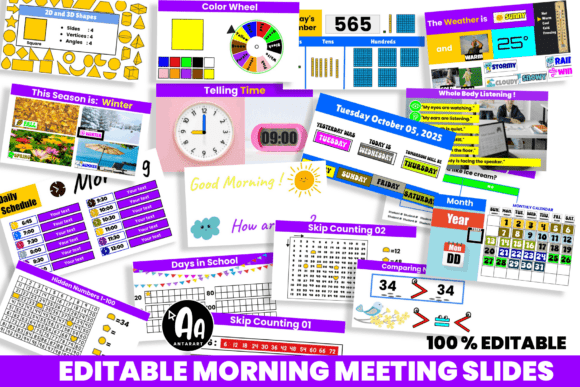
A robust digital morning meeting resource is not merely a collection of random slides; it is a carefully sequenced workflow designed to engage young learners immediately upon entering the classroom. The architecture typically begins with a Greeting slide, which sets the tone for social interaction. In a digital format, this can include animated characters or customizable text fields that allow teachers to insert student names, fostering a sense of belonging. Following the greeting, many effective decks incorporate Whole Body Listening rules. These visual reminders are crucial for classroom management, explicitly teaching students the physical behaviors associated with active listening before academic instruction begins.
The core of the routine often transitions into logistical organization via a Morning/Evening schedule slide. This visual timeline helps students understand the flow of the day, reducing anxiety and improving transitions. From there, the cognitive engagement ramps up with Question of the Day prompts. These open-ended inquiries encourage critical thinking and oral language development, serving as a bridge between the social aspect of the meeting and the academic rigor of the math block that follows.
The true power of these Digital Resources lies in their modularity. Because they are often provided as editable files, teachers can rearrange the sequence to fit specific grade-level needs or district pacing guides. A kindergarten teacher might spend twenty minutes on the weather and seasons, while a third-grade instructor might accelerate through those elements to focus deeply on place value and multiplication patterns. This flexibility ensures that the tool serves the pedagogy, rather than dictating it.
Deconstructing Calendar Math: Beyond Counting Days
When educators refer to Calendar Math, they are describing a spiral review approach to mathematics that occurs daily. Unlike isolated math lessons, calendar math integrates multiple domains—number sense, geometry, measurement, and data analysis—into a single, cohesive activity. The Date slide is the foundational element here. It goes beyond simply stating today's date; it requires students to manipulate concepts of yesterday, today, and tomorrow, reinforcing the linear nature of time. By interacting with digital elements representing days, months, and years, students internalize the structure of the Gregorian calendar.
Visual literacy plays a significant role in this section. High-quality slides include Seasons and weather visuals that are not just decorative but functional. Students might drag and drop icons to represent current conditions, subsequently collecting data over a month to create graphs. This introduces early statistical concepts naturally. Similarly, the inclusion of a Color wheel within the math segment supports cross-curricular connections, helping students categorize and sort objects, a precursor to more complex algebraic thinking.
One of the most sophisticated components of advanced calendar math decks is the focus on Telling time clocks. Digital slides often feature movable clock hands, allowing teachers to model specific times while students replicate the action on individual whiteboards or through verbal responses. This immediate feedback loop is vital for mastering the abstract concept of time. Furthermore, the integration of 2D and 3D shapes posters within the slide deck ensures that geometric vocabulary is reviewed daily, moving shapes from passive poster art to active discussion points.
Number Sense and Place Value Mastery
The mathematical heavy lifting in these routines occurs during the number sense segments. A comprehensive set of Morning Meeting Slides will include a Place value of today's number activity. Here, the date or a specific "number of the day" is decomposed into hundreds, tens, and ones. In a digital environment, this can be visualized using base-ten blocks that appear on screen as students count, providing a concrete representation of abstract values.
To deepen this understanding, many resources incorporate Number comparison charts. Students analyze the day's number against previous numbers, using greater than, less than, and equal to symbols. This daily repetition builds fluency and confidence. Additionally, the Hidden number chart 1–100 is a powerful gamification element. By revealing numbers one by one or hiding specific digits, teachers challenge students to use context clues and pattern recognition to identify missing values. This exercise sharpens logical deduction skills and reinforces the structure of the base-ten system.
Skip counting is another area where digital slides excel. Skip counting tables and Hidden skip counting numbers activities allow for rhythmic, choral counting that supports multiplication readiness. The visual highlighting of patterns (e.g., counting by 5s or 10s) on a large screen ensures that all students, including those in the back of the room or participating remotely, can clearly see the numerical relationships.
Implementation Strategies for Diverse Classrooms
The utility of Editable Morning Meeting Math Calendar Slides extends across various educational settings. For general education teachers, these slides provide a consistent framework that reduces planning time while ensuring high-quality instruction. The Days in school tracker is a prime example of a long-term project embedded in the daily routine. As students accumulate days, they physically bundle straws or update digital counters, culminating in a celebration of the 100th day of school. This longitudinal activity teaches perseverance and the magnitude of large numbers.
For special education professionals and interventionists, the visual consistency of these slides is invaluable. Students who thrive on predictability benefit from the unchanging layout of the Thanks slide and the recurring sequence of activities. The ability to edit text and images means that instructions can be simplified, fonts enlarged, or colors adjusted to accommodate visual impairments or processing differences. The Whole Body Listening rules can be customized with photos of the actual students in the class, making the expectations more tangible and relatable.
In hybrid or remote learning environments, these Google Slides or PowerPoint files become even more critical. They serve as the focal point for synchronous video meetings, keeping distant learners engaged in the same communal activities as their in-person peers. The interactive elements, such as dragging weather icons or uncovering hidden numbers, can often be adapted for student use on their own devices, turning a passive viewing experience into an active learning session.
Maximizing Engagement Through Modern Design
The aesthetic quality of instructional materials directly impacts student engagement. Outdated, clip-art-heavy slides can fail to capture the attention of digital-native students. Modern design resources utilize clean lines, harmonious color palettes, and intuitive icons to maintain focus. A well-designed Color wheel or Seasons weather visuals slide should look professional and inviting. When the visual presentation is high-quality, students perceive the content as more valuable and are more likely to participate actively.
Furthermore, the "editable" nature of these files empowers teachers to become creators. Rather than being confined to a rigid script, an educator can swap out the Question of the Day to align with a current event, a holiday, or a specific science topic being studied. This responsiveness makes the morning meeting feel alive and relevant. It demonstrates to students that their learning is connected to the real world, not just confined to a textbook.
Long-Term Educational Impact
The cumulative effect of daily exposure to Calendar Math and structured morning meetings is profound. Research in early childhood education suggests that consistent routines improve executive functioning skills, such as working memory and cognitive flexibility. By daily practicing the sequencing of days, the decomposition of numbers, and the identification of patterns, students build a strong neural foundation for future mathematical success.
Vocabulary acquisition is another significant benefit. Terms like "equivalent," "cylinder," "analog," and "forecast" become part of the students' active vocabulary through repeated, contextualized use. The 2D 3D shapes posters and Telling time clocks are not just memorized; they are discussed and manipulated. This depth of processing leads to better retention and transfer of knowledge to standardized testing situations and real-world problem-solving scenarios.
Moreover, the social-emotional component cannot be overstated. Starting the day with a greeting and a shared routine fosters a classroom culture of respect and collaboration. The Thanks slide at the end of the meeting provides a moment of gratitude and closure, reinforcing positive behavior and community bonds. In an era where mental health and social skills are prioritized alongside academics, this dual focus is essential.
Selecting the Right Resource for Your Needs
With a myriad of options available on educational marketplaces, selecting the right set of Morning Meeting Slides requires careful consideration. Educators should look for resources that offer both Google Slides and PowerPoint compatibility to ensure accessibility regardless of the school's technology infrastructure. The inclusion of a comprehensive What's included list is vital; a superior package will contain all the previously mentioned elements, from the Hidden number chart to the Monthly calendar views.
It is also important to evaluate the level of interactivity. Static slides are less effective than those designed for manipulation. Can the teacher move the clock hands? Can the weather icons be dragged? Is the text editable without breaking the design layout? These features determine whether the resource will be a versatile tool or a rigid constraint. Additionally, checking for updates and support from the creator ensures that the resource remains compatible with software updates and continues to meet evolving educational standards.
In conclusion, the integration of Calendar Math and Morning Meeting Slides represents a best practice in elementary education. By combining rigorous mathematical review with social-emotional grounding in a visually engaging, editable digital format, teachers can create a morning routine that is both efficient and deeply impactful. Whether tracking the Days in school, exploring Place value, or discussing the Seasons, these tools provide the scaffolding necessary for young learners to thrive academically and socially. As classrooms continue to evolve, the adaptability and depth of these digital resources will remain a cornerstone of effective daily instruction.