Evaluating the Plain Mini Envelope Template 3.687x2.687 for Custom Packaging Projects
When embarking on a small-scale packaging project, whether for a boutique jewelry line, wedding favors, or personalized stationery, the selection of a dieline is the foundational step that determines both aesthetic appeal and structural integrity. The Plain Mini Envelope Template 3.687x2.687 represents a specific category of digital assets designed for precision crafting. Unlike generic shapes found in basic design software, this template offers a pre-engineered solution tailored to a compact footprint, measuring exactly 3.687 by 2.687 inches. For designers and hobbyists evaluating resources, understanding the distinct advantages of using a dedicated vector dieline versus creating one from scratch is essential for efficient workflow management.
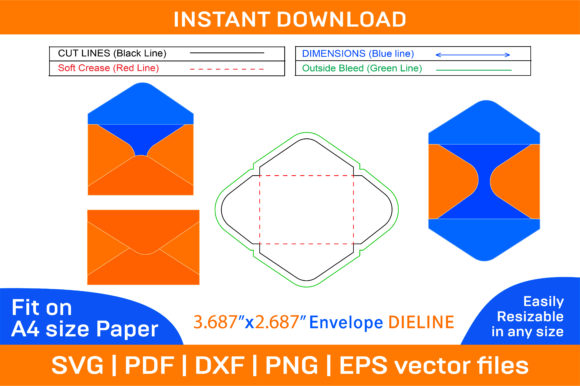
This specific template serves as a versatile starting point for creating foldable boxes and mini envelopes. It is not merely an image but a functional tool provided in a comprehensive ZIP archive containing SVG, PDF, EPS, DXF, AI, and PNG files. This variety ensures compatibility across a wide spectrum of design environments, from professional graphic suites like Adobe Illustrator and Photoshop to consumer-grade cutting machine software such as Silhouette Studio and Cricut Design Space, and even CAD programs like AutoCAD. The inclusion of both color and blank templates within the archive allows users to visualize the final fold lines immediately or start with a clean slate to print on colored stock, offering flexibility that static images cannot match.
Structural Precision vs. Generic Design Approaches
One of the primary considerations when choosing a packaging resource is the reliability of the dimensions. The Plain mini envelope template 3.687x2.687 inch dieline template is engineered with specific tolerances for folding and gluing. When comparing this to a "draw-it-yourself" approach, the value becomes clear. Manually calculating glue tabs, fold scores, and bleed areas for a box of this specific size requires a deep understanding of material thickness and structural engineering. A miscalculation of even a fraction of a millimeter can result in a box that does not close properly or gaps that compromise the contents.
In contrast, utilizing a pre-made 3D envelope vector file eliminates the guesswork. The 3.687x2.687 inch specification suggests a form factor ideal for holding small items like coins, seeds, tea bags, or gift cards. While larger box templates exist for bulkier products, they often lack the nuanced fold lines required for smaller, delicate structures. Conversely, templates designed for extremely miniature items may be too fragile for general use. This specific size occupies a "sweet spot" in the packaging world—large enough to be handled easily by adults, yet small enough to feel exclusive and精致 (exquisite).
Furthermore, the distinction between raster-based images and the vector-based nature of this template is critical. Many free resources online are provided solely as JPEGs or low-resolution PNGs. These formats degrade when resized and do not provide the crisp cut lines necessary for die-cutting machines. The files in this archive are vector-based, meaning the quality remains pristine regardless of scaling. Although optimized for A4 paper, the mathematical paths defining the shape allow for printing on any size of paper without pixelation, ensuring that the cut lines remain sharp for machines like the Silhouette or Cricut to follow accurately.
Material Compatibility and Production Workflows
The utility of any printable box template is heavily dependent on how it interacts with various materials. The Plain Mini Envelope Template 3.687x2.687 is designed with standard paper weights in mind, typically ranging from lightweight cardstock to heavier cover stocks. When evaluating this template against others, one must consider the intended production method. For home crafters using inkjet or laser printers, the high-resolution 300 DPI PNG files included in the package provide a reliable reference for alignment. However, for professional print shops, the AI, EPS, and PDF files are superior as they retain editable paths and color profiles.
A significant advantage of this resource is the dual-template approach: one version with guide colors and one completely blank. This addresses a common pain point in custom packaging. Some designers prefer to see the fold lines and glue tabs in contrasting colors during the design phase to ensure their artwork does not get obscured by a crease. Others, particularly those printing on textured or colored paper, require a version with no background elements to avoid white halos or interference with the substrate. Having both options in a single download streamlines the decision-making process, allowing the user to adapt the workflow to their specific printer capabilities and material choices.
It is also worth noting the compatibility with industrial and semi-industrial tools. The inclusion of DXF files bridges the gap between graphic design and engineering, making this template usable in AutoCAD for those who need to integrate the envelope shape into larger mechanical assemblies or laser-cutting setups. This versatility sets it apart from templates that are exclusively formatted for consumer crafting apps, which often lack the precision required for batch production or specialized machinery.
Customization Potential and Creative Limitations
While the Plain Mini Envelope Template 3.687x2.687 offers a robust foundation, it is important to recognize its role as a "blank canvas." The term "plain" in the title indicates that the artistic heavy lifting rests with the user. This is a deliberate trade-off. Pre-designed templates with built-in patterns or themes offer speed but limit creative control. A plain template, conversely, demands more time for branding and decoration but yields a truly unique product. Users can apply their own logos, patterns, and color schemes to align perfectly with their brand identity or event theme.
For instance, a wedding planner might use the blank template to print on pearlescent paper, adding gold foil accents that a pre-printed template could not accommodate. A small business selling artisanal soaps could utilize the color template to map out exactly where their label will sit relative to the fold lines, ensuring no text is lost in the crease. The ability to customize every inch of the surface area makes this template a powerful tool for branding, provided the user has access to design software capable of editing vector files.
However, there are limitations to consider. Because this is a fixed-size dieline, it cannot be arbitrarily stretched to fit larger products without distorting the proportions of the glue tabs and flaps. If a user needs to package an item slightly larger than the 3.687x2.687 inch capacity, they would need to seek a different template size rather than modifying this one significantly. Additionally, while the vector files are scalable for printing, the structural physics of the paper remain constant; scaling the file up to create a giant box using standard paper would result in a structurally unsound container. This template is best suited for its intended scale or slight reductions, rather than massive expansions.
Decision Factors: Is This Template the Right Fit?
Determining whether to utilize the Plain Mini Envelope Template 3.687x2.687 involves weighing several factors against project requirements. First, consider the volume of production. For one-off projects or small batches, the instant download capability and compatibility with home printers make this an cost-effective solution. There is no need to pay for custom die creation or minimum order quantities associated with professional packaging manufacturers. Second, evaluate the technical skill level. Users comfortable with layers in Illustrator or settings in Cricut Design Space will find immense value here. Those entirely new to vector graphics may face a steeper learning curve compared to using a physical stencil, though the included PNGs offer a simpler alternative for basic tracing.
Another crucial factor is the timeline. Since the files are available for instant download, there is no waiting period for shipping physical templates. This immediacy is vital for last-minute events or rapid prototyping. However, users must account for the time required to print, cut, score, and assemble. Unlike pre-folded boxes that arrive ready to fill, this template requires labor. For high-volume needs where labor costs outweigh material savings, purchasing pre-made boxes might be more efficient. But for scenarios where customization and uniqueness are paramount, the effort invested in assembling these custom boxes pays off in perceived value.
Finally, the format diversity supports a wide range of end-users. A graphic designer might prefer the AI file for seamless integration into a brand kit, while a hobbyist with a Silhouette machine might rely on the SVG. The presence of the 3D envelope vector file concept also hints at the potential for digital mockups, allowing creators to visualize their design in a three-dimensional space before committing to printing. This reduces waste and ensures the final physical product meets expectations.
In summary, the Plain Mini Envelope Template 3.687x2.687 stands out as a highly adaptable, professional-grade resource for those who prioritize customization and precision. It bridges the gap between amateur crafting and professional packaging design by providing the necessary technical specifications in accessible formats. While it requires user input for design and assembly, the trade-off results in a bespoke packaging solution that generic alternatives simply cannot replicate. Whether for commercial products or personal gifts, this template offers a reliable, high-quality foundation for bringing small-scale packaging ideas to life.