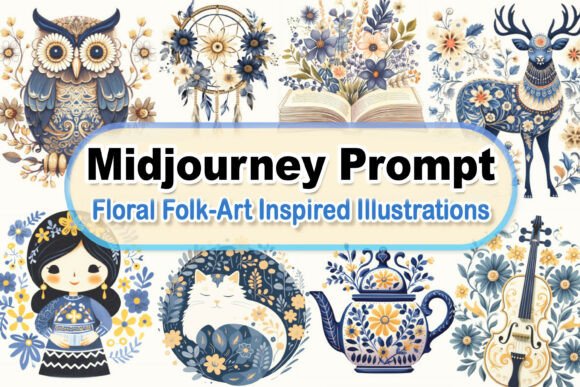
Evaluating the Editable Prompt for Floral Folk-Art Design
In the rapidly evolving landscape of digital art and design, tools that bridge the gap between conceptual ideas and visual execution are increasingly valuable. One such tool gaining attention is the Editable Prompt - Floral Folk-Art Design. This product represents a shift from purchasing static assets to acquiring the instructions necessary to generate custom imagery using artificial intelligence. For designers, crafters, and hobbyists, understanding the utility, limitations, and practical applications of such a prompt is essential before making a purchase decision.
Understanding the Product Nature
It is crucial to establish immediately what this product is and, perhaps more importantly, what it is not. The Editable Prompt - Floral Folk-Art Design is not a collection of pre-rendered images, clipart, or vector files. Instead, it is a text-based instruction set, typically delivered via a PDF file, designed to be used within AI image generation platforms such as MidJourney, DALL·E, or Leonardo. The core value proposition lies in its editability; users are provided with a structured sentence framework where specific variables—such as subject matter, color palettes, or compositional elements—can be swapped out to create unique outputs.
The prompt specifically targets a "Floral Folk-Art" aesthetic, often characterized by delicate details, stylized botanical elements, and a handcrafted feel. Some variations of these prompts also incorporate modern rendering techniques, such as realistic pastel 3D liquid flow patterns, allowing for a fusion of traditional artistic styles with contemporary digital textures. When evaluating this tool, one must view it as a recipe rather than a finished meal; the quality of the final image depends heavily on how the user utilizes the provided instructions.
Reasons for Interest and Potential Benefits
There are several compelling reasons why a creative professional or enthusiast might consider acquiring an editable prompt over generating images from scratch or buying stock photography.
- Customization and Personalization: The primary advantage is the ability to insert specific subjects into a proven artistic style. For instance, a pet owner could replace a placeholder variable with a description of their specific dog breed, generating folk-art portraits that match a consistent visual theme without needing to commission a human artist for every variation.
- Consistency in Branding: For small business owners creating product designs, stickers, or printables, maintaining a cohesive look across different items is vital. Using a single, well-structured prompt ensures that whether you are generating a floral pattern for a mug or a poster, the underlying artistic style remains uniform.
- Efficiency in Workflow: Crafting effective AI prompts requires a degree of trial and error and an understanding of how different models interpret language. A professionally written prompt saves time by providing a tested structure that yields high-quality results quickly, bypassing the initial learning curve associated with prompt engineering.
- Versatility Across Mediums: Because the output is generated digitally, the resulting images can be adapted for various uses, including seamless patterns for textiles, high-resolution prints for wall art, or digital assets for web design.
Tradeoffs and Critical Considerations
While the benefits are significant, potential buyers must weigh them against certain tradeoffs and realistic expectations. The most notable consideration is the requirement for access to an external AI image generator. The prompt itself does not create images; it merely instructs another software to do so. Therefore, the user must already have a subscription to a service like MidJourney or access to a platform like Leonardo.ai. This adds an ongoing cost and a layer of technical dependency to the process.
Furthermore, the term "editable" implies a need for user input. To achieve the best results, the user must understand how to modify the prompt correctly. Replacing bracketed signs (e.g., [xxx]) with appropriate descriptors requires a basic grasp of descriptive language. A user who inputs vague or conflicting terms may not achieve the "delicate realistic details" advertised, regardless of the quality of the base prompt.
Another factor is the variability of AI output. Even with a perfect prompt, AI generators produce stochastic results. Users may need to run the prompt multiple times to find an image that perfectly matches their vision. This contrasts with buying a specific clipart pack where the image is exactly what is seen in the preview. The preview images shown in marketing materials for the Editable Prompt - Floral Folk-Art Design are demonstrations of potential, not guarantees of identical output for every user.
Ideal Use Cases
This tool is a strong fit for specific scenarios where customization and volume are prioritized over immediate, one-off asset acquisition.
- Print-on-Demand Entrepreneurs: Individuals selling custom merchandise benefit greatly from the ability to generate endless variations of a design theme without infringing on copyrights or paying per-image licensing fees.
- Event Planners and Crafters: Those creating personalized invitations, favors, or decorations for weddings and parties can use the prompt to tailor floral motifs to specific color schemes or include symbolic flowers relevant to the event.
- Digital Artists Seeking Inspiration: Artists who use AI as a starting point for further manual editing in software like Photoshop or Procreate will find the structured composition of folk-art designs to be an excellent base layer for their work.
When to Consider Alternatives
Conversely, there are situations where alternatives may be more appropriate. If a user needs an image immediately and lacks the time or patience to iterate through AI generations, purchasing a ready-made stock photo or a dedicated clipart bundle is a more efficient route. Similarly, if a project requires absolute precision in vector format (SVG) for large-scale signage, a manually created vector illustration from a graphic designer may offer better scalability and control than a raster image generated by AI, even if that image is upscaled later.
Additionally, users who are uncomfortable with technology or do not wish to manage subscriptions to AI platforms should avoid this product. The value is entirely contingent on the user's ability to operate the generative software effectively.
Making the Decision
Deciding whether the Editable Prompt - Floral Folk-Art Design aligns with your goals comes down to assessing your workflow needs. If you value flexibility, plan to create multiple variations of a theme, and are comfortable navigating AI tools, this prompt offers a cost-effective method to expand your creative library. It transforms the user from a passive consumer of art into an active director of the creative process.
However, if your requirement is for a single, specific image with no need for modification, or if you prefer a hands-off approach to asset creation, traditional stock libraries remain a viable alternative. Ultimately, this product serves as a powerful lever for creativity, provided the user is willing to engage with the mechanics of AI generation to pull it.